
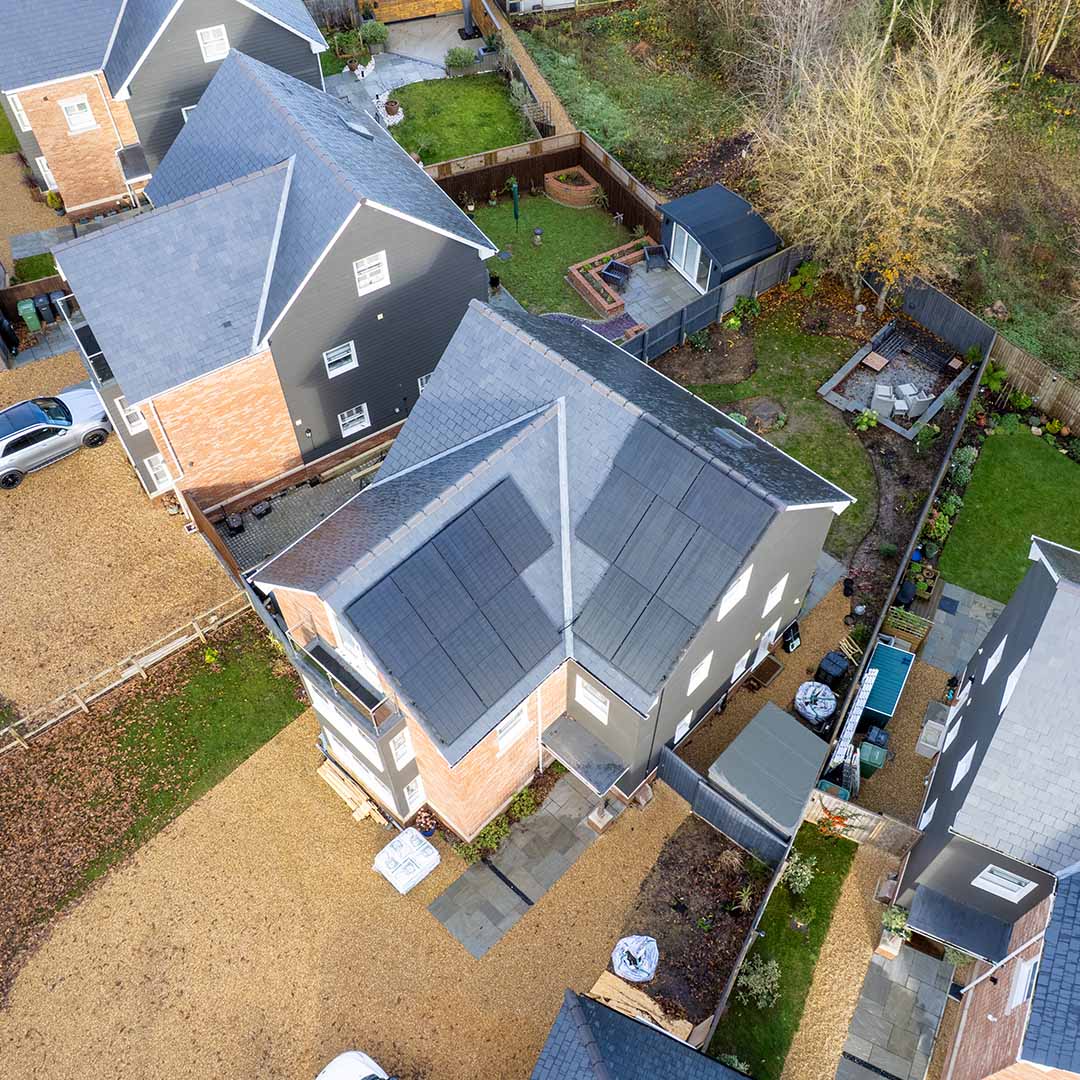
Yes, you can almost always retrofit a battery to existing solar panels. Here is how it works on South Coast homes, what it costs, and when it makes sense.
If you had solar panels fitted a few years ago without storage, you are far from alone. Plenty of South Coast homes installed solar when batteries were expensive and the old Feed-in Tariff actively rewarded exporting everything to the grid. Times have changed, and the question we hear most often from those owners is a simple one: can I add a battery now, without ripping anything out? The short answer is yes, in almost every case you can, and for many households it is one of the better upgrades you can make to a system you already own.
A retrofit battery is added alongside your existing setup rather than replacing it. Your panels and their existing inverter keep doing their job; the battery and its own electronics simply sit between your home and the grid, capturing the surplus that used to flow out to SSEN or UKPN for a modest export payment. Instead of selling that midday excess cheaply and buying it back at the full evening rate, you store it and use it yourself after dark. On the South Coast, where Solent irradiance of roughly 1,050 to 1,150 kWh per kWp means many systems produce a healthy daytime surplus, there is often a meaningful amount of energy to capture.
There are two main ways to wire a retrofit, and which suits you depends on your existing kit. The most common is an AC-coupled battery, which has its own built-in inverter and connects to your home's electrical system independently of your solar inverter. This is the flexible option because it works with virtually any existing solar array regardless of brand or age. The alternative is DC-coupling, where the battery ties into a hybrid inverter on the solar side; this can be marginally more efficient but usually only makes sense if your current inverter is already a hybrid or is due for replacement anyway. For most retrofits on older systems, AC-coupling is the straightforward, sensible route.
Compatibility is rarely a dealbreaker, but it is worth a proper look. We check the age and condition of your existing inverter, the spare capacity in your consumer unit, your typical daily consumption, and whether you have an EV or are planning one. We also look at how much you currently export, because that surplus is exactly what a battery is there to mop up. A home that exports very little because it already uses most of its solar during the day will see less benefit from storage than a household out at work all day that currently gives most of its generation away.
Cost is the part people most want straight talk on. A typical retrofit battery for a South Coast home runs from around 3,000 to 5,000 pounds installed, depending on capacity and brand, with larger or premium units costing more. The good news is that batteries installed as part of a solar energy storage upgrade currently qualify for 0% VAT, which keeps the price down. We will never quote you a guaranteed figure off a phone call, because the right size depends on your usage, but a typical 5kWh to 10kWh battery sits comfortably in that band for most homes.
Will it pay back? Honestly, that depends on your numbers, and we would rather be upfront than sell you on a brochure promise. The savings come from the gap between what you pay to import power and what you would have earned exporting it. If you import at around 25p and your Smart Export Guarantee rate is around 12p (Octopus Outgoing was cut from 15p to 12p on 1 March 2026), every stored unit you reuse is worth roughly the difference plus the avoided import. Pair that with a time-of-use tariff such as those from Octopus, where you can also charge the battery from cheap overnight electricity, and the maths improves considerably. For many South Coast homes a retrofit battery pays back in roughly seven to eleven years, though heavy evening users and EV owners often do better.
A retrofit also unlocks options your original solar-only system did not have. With a battery and the right smart tariff, you can charge overnight when grid power is cheapest and use it through the expensive evening peak, which is valuable even on the dullest winter days when your panels generate little. Add an EV and the case strengthens again, because you can shift charging to the cheapest hours and lean on stored solar for the rest of the house. Some batteries can also be configured to provide backup power during an outage, though that is a specific feature worth confirming rather than assuming.
The practical side is reassuringly undramatic. A retrofit is typically a one-day job for our installers, with no scaffolding and no disruption to your roof, since we are working at the inverter and consumer-unit end rather than up top. As an MCS-certified, family-run installer we handle the SSEN or UKPN notification for you, update your system documentation, and make sure your Smart Export Guarantee arrangement still reflects the new setup. There are no pushy sales here; if your existing system is genuinely too old or too small to benefit, we will tell you plainly.
If you have solar already and have been watching your export readings climb while your evening bills stay high, a battery is often the missing piece. The best starting point is to look at your actual usage rather than a generic estimate. Try our solar battery calculator to see how much you could realistically store and save, or get in touch for a free, no-obligation quote and we will model it against your real numbers.
Thinking about solar for your home?
We design every system around your roof and your real usage, across Hampshire, the Isle of Wight, Surrey, Sussex and Dorset. Get a free, no-obligation quote →
Cornerstone guide
Best Solar Battery UK 2026: Buyer's Guide →Read next
Battery Storage Without Solar: Is It Worth It?
You don't need solar panels to benefit from a home battery. Here's how battery storage on a cheap overnight tariff stacks up for South Coast homeowners.
Fox ESS vs GivEnergy vs Tesla: Home Batteries Compared
An honest comparison of three popular home batteries — Fox ESS, GivEnergy and Tesla Powerwall — for South Coast homeowners weighing capacity, cost and support.
How Much Money Can a Home Battery Actually Save You?
Real numbers on what a home battery saves South Coast homeowners — with and without solar, on smart tariffs — and the levers that make the biggest difference.