
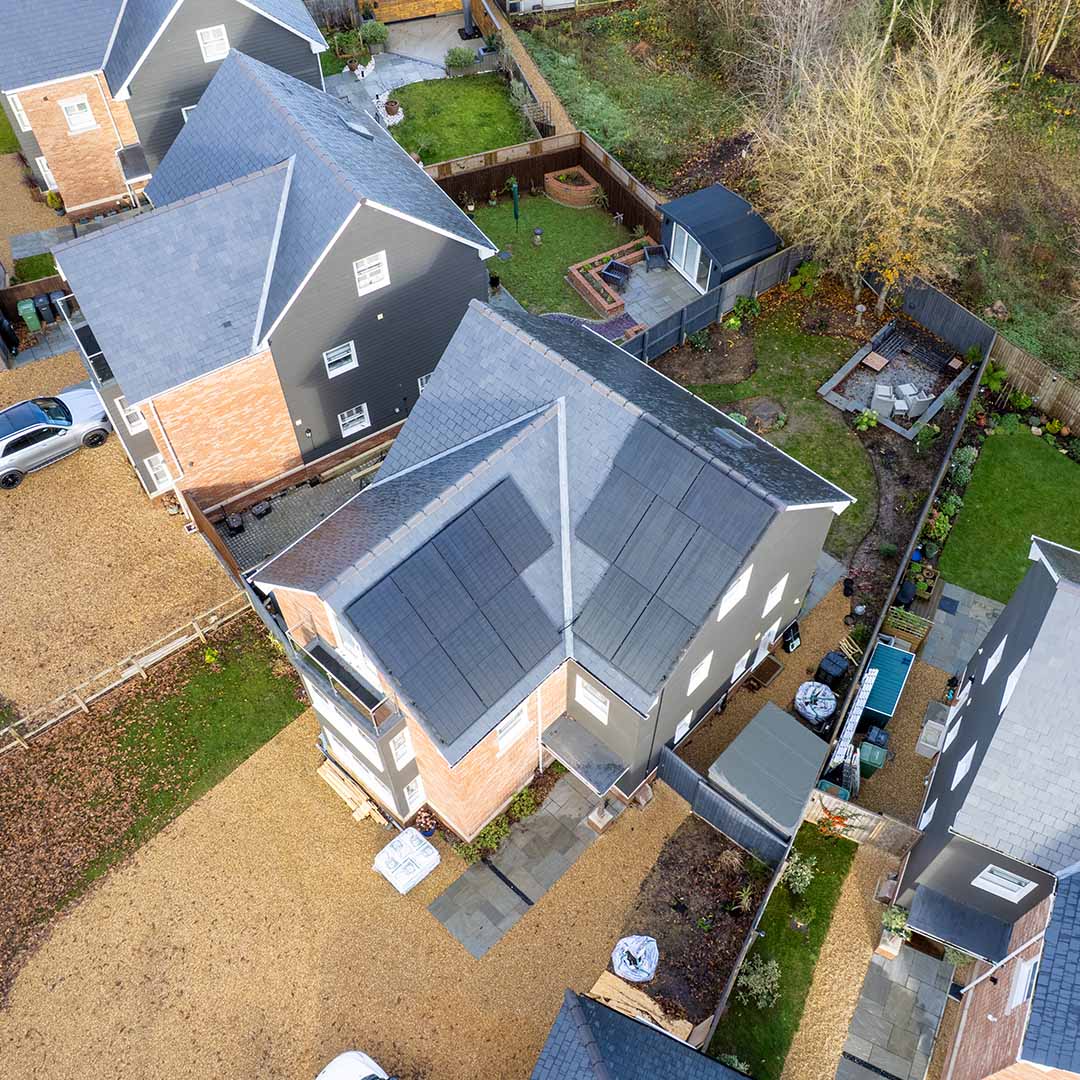
How conservation areas, listed buildings and permitted development rules affect solar in and around Chichester, and how local homeowners can still go solar.
Chichester is one of the most historic and architecturally protected places on the South Coast, and that gives solar a particular character here. The cathedral city centre, the Georgian streets of the Pallants, and a string of surrounding villages contain conservation areas and listed buildings where what you can and can't fit to a roof is more tightly governed than in a typical modern estate. The good news is that solar is far from off-limits in Chichester, but the route to it needs more care than elsewhere. Understanding the rules early saves time, money and disappointment, and it's the single most useful thing a Chichester homeowner can do before getting quotes.
For most homes in England, solar panels are covered by permitted development rights, meaning you can install them without a full planning application provided they meet certain conditions, such as not projecting too far above the roof slope and not being installed on a wall facing a highway in a conservation area. That permitted development framework is what makes solar quick and simple for the majority of UK homeowners. In Chichester, however, those rights are often restricted precisely because so much of the area carries conservation or listed status, so the standard assumptions don't automatically apply to your property.
Conservation areas are the most common consideration in and around Chichester. Within a conservation area, permitted development still exists, but with extra limits, the key one being that panels generally should not be fitted to a roof slope that fronts a highway. In practice, that often means panels on the rear or a discreet side roof are acceptable under permitted development, while a prominent street-facing array may require planning permission from Chichester District Council. The character of the area is what's being protected, so the more visible the proposed panels are from public spaces, the more likely the council is to want a say. A pre-application enquiry to the council is a sensible, low-cost way to get clarity before committing.
Listed buildings are a separate and stricter matter, and Chichester has many of them. If your home is listed, at any grade, you will almost always need listed building consent to install solar panels, regardless of where on the roof they go, because the listing protects the building's special interest both inside and out. This is not a reason to give up. Plenty of listed properties have successfully added solar, particularly where panels can be placed out of sight on a rear roof, an outbuilding or a garage, or where conservation-style panels that sit flush and dark are used to minimise visual impact. The process simply requires consent and a sympathetic design, and it's worth engaging a conservation officer's view early.
The villages and countryside around Chichester add another layer, because much of the area sits within or close to the South Downs National Park and the surrounding Area of Outstanding Natural Beauty. Within these designations, planning authorities take landscape and visual impact seriously, and roof-mounted solar that's clearly visible from open countryside or public viewpoints can attract more scrutiny. Ground-mounted arrays in rural gardens are also more tightly controlled in these settings. Again, none of this rules solar out, but it does mean a thoughtful, well-documented approach pays off, and that a local installer who has navigated South Downs planning before is genuinely valuable.
From a design point of view, there's a lot you can do to make solar work harmoniously in a sensitive Chichester setting. All-black panels with black frames and mounting rails are far less obtrusive than older blue-and-silver products and are often more readily accepted in conservation contexts. In-roof or integrated systems, which sit flush within the roof plane rather than standing proud on rails, can look almost like a rooflight and are sometimes the difference between approval and refusal on a visible slope. Careful layout that keeps panels within a clean rectangle, away from roof edges and chimneys, also reads as more considered to planners and neighbours alike.
Once the planning side is settled, the rest of a Chichester installation follows the same logic as anywhere on the sunny South Coast. The area benefits from strong Solent-influenced irradiance, broadly 1,050 to 1,150 kWh per kWp a year, so a well-sited array generates well. Your distribution network operator for Chichester and most of Sussex is UK Power Networks, UKPN, rather than SSEN, and your installer will handle the grid notification or connection application with UKPN as part of the job. Surplus energy can be sold back through the Smart Export Guarantee, with smart tariffs such as those from Octopus pairing nicely with a battery, and residential solar carries 0% VAT.
On cost, Chichester homeowners should expect the same broad ranges as the wider region, with a typical 3.5 kWp to 4 kWp system starting from around £5,000 to £7,000 fully installed and batteries adding roughly £2,500 to £5,000. Conservation-grade or integrated panels can sit at the higher end because the product and the careful installation cost a little more, and there may be a modest planning or consent fee where an application is needed. These are ranges to guide your thinking rather than fixed prices, and an accurate figure always comes from a proper survey of your specific roof and circumstances.
The practical takeaway for Chichester is simple: check your property's conservation, listing and National Park status before anything else, and lean on an installer who understands the local planning landscape. Getting the design and the paperwork right from the start is what turns a heritage home into a quiet solar success rather than a planning headache. As a family-run, MCS-certified installer covering Chichester and the Sussex coast, we're happy to advise honestly on what's likely to be permitted, with no pushy sales. Get in touch for a free quote, or try our solar calculator to see what your roof could generate.
Thinking about solar for your home?
We design every system around your roof and your real usage, across Hampshire, the Isle of Wight, Surrey, Sussex and Dorset. Get a free, no-obligation quote →
Cornerstone guide
Solar Panels on the South Coast: The Complete Regional Guide →Read next
Solar Panels in Southampton: Costs, Roofs & Grid Connection
A practical look at what solar costs in Southampton, the roof types across the city, and how SSEN grid connections work for local homeowners.
Solar Panels in Bournemouth & Poole: A Dorset Guide
What homeowners in Bournemouth and Poole need to know about solar costs, roof types, coastal conditions, grid connection and exporting energy in Dorset.
South Coast Sunshine Hours: Why the Solent Beats the UK Average
A clear explanation of why the South Coast gets more sunshine than most of the UK, and what that means for solar generation, savings and payback.