

West Sussex · PO19 and PO20
Solar Panels Chichester: Installers for PO19 and PO20
Solar, battery storage and EV charging in Chichester — designed and installed by a local, MCS-certified team based in Portsmouth.
Quick answer
Chichester (PO19/PO20) is in the SSEN (Scottish and Southern Electricity Networks) distribution area, and we handle the G98/G99 application for you. We design discreet, all-black systems for the city's Georgian conservation areas, and PVGIS models about 4,698 kWh a year for an unshaded 4kW south-facing array here — the highest of the towns we cover.
Chichester is an affluent West Sussex cathedral city, ringed by the South Downs and the harbour, with a Georgian core of high-value townhouses and a spread of comfortable suburbs and rural villages. It is exactly the kind of heritage-rich, owner-occupier market where careful, sympathetic solar design pays off — and where we already work regularly.
A short 18-mile run east of our Portsmouth base, Chichester connects to the grid through Scottish and Southern Electricity Networks (SSEN), the same operator as our Hampshire home patch, with UK Power Networks taking over further east along the Sussex coast. We handle the correct G98/G99 application for your postcode automatically.
Solar in Chichester: the local detail
Grid connection (DNO)
Chichester is in the SSEN area — the same operator as our Hampshire home patch; UK Power Networks takes over further east in Sussex. G98 covers smaller systems; G99 (applied for in advance) covers batteries and larger arrays — SCSS files the application.
Local planning authority
Chichester District Council (with the South Downs National Park Authority for properties inside the park)
Heritage & conservation
Extensive — the city-walls conservation area, Georgian townhouses around the Pallants, and listed properties near the Cathedral often need Listed Building Consent; all-black, low-profile, rear-slope systems are standard.
Local housing stock
Georgian and Victorian townhouses in the centre, 20th-century suburbs (Summersdale, Whyke), rural detached at Lavant and Fishbourne, and high-value coastal homes around West Wittering.
Typical roofs
Heritage slate and clay roofs needing sensitive fixings in the centre; large unshaded rural roofs inland; SDNP visual-impact considerations.
Sunlight & generation
PVGIS models about 4,698 kWh a year for a 4kW unshaded, south-facing array at a 35° pitch
Areas we cover in & around Chichester
Summersdale · Whyke · Fishbourne · Lavant · Donnington · West Wittering
~18 miles east of HQ; regular presence on the PO/BN corridor.
A nearby installation
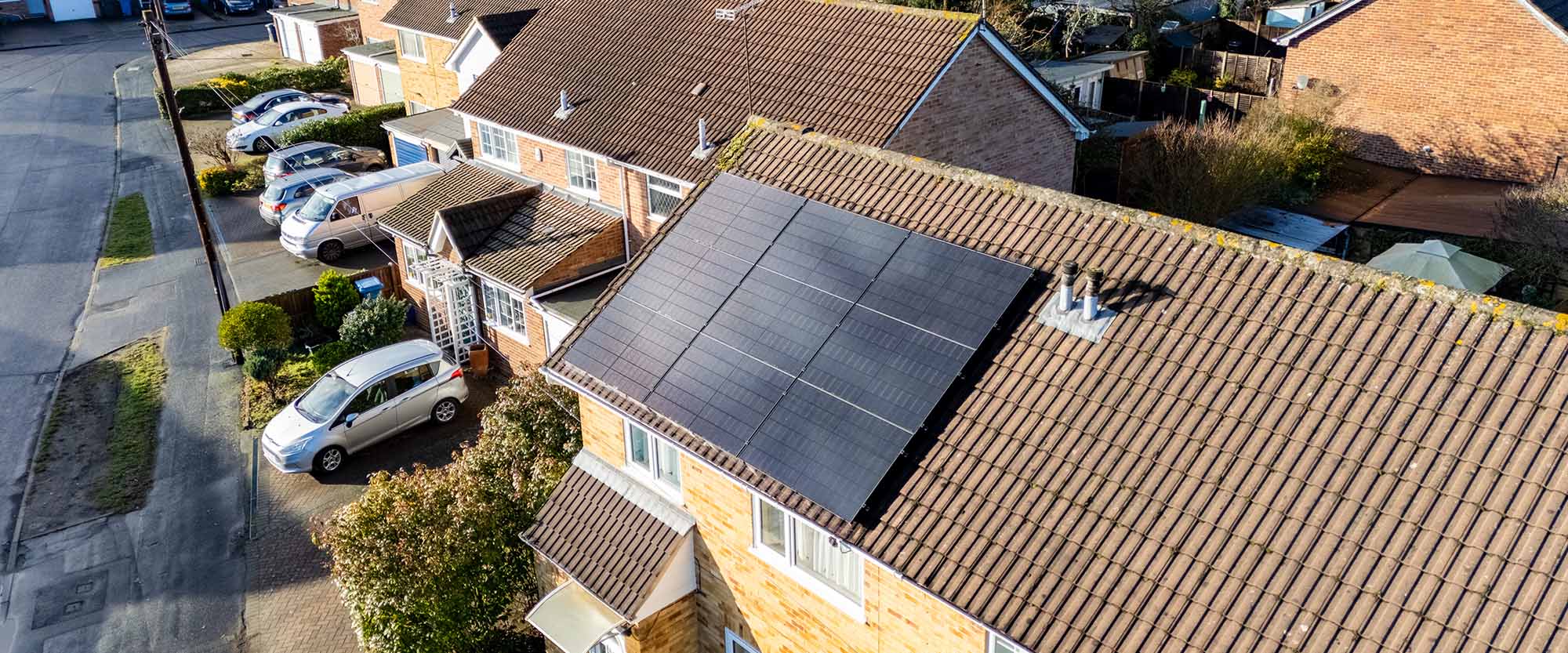
Tesla Powerwall Installation
East Sussex · 7.62kWp · 80% bill reduction
Our Chichester services
Solar Only
Generate clean energy, reduce your bills, and take the first step towards energy independence.
Solar & Battery
Maximise your energy, reduce costs and increase independence with a combined solar and battery system.
Battery Only
Flexible, efficient battery storage for every home — even without solar panels.
EV Charging
Charge at home, efficiently and cost-effectively with smart EV charging solutions.
Nearby areas
FAQ
Solar panels in Chichester: your questions
How much do solar panels cost in Chichester?
Do I need planning permission for solar panels in Chichester?
Which electricity network (DNO) covers Chichester?
How much electricity will solar panels generate in Chichester?
Which parts of Chichester do you cover?
Installing Solar Panels in Chichester's Conservation Areas and Historic Streets
Chichester is not a city where a one-size-fits-all solar install works. Inside the city-walls conservation area — and on the Georgian townhouses around the Pallants — the priority is a system that disappears into the roofline. Our standard specification here is all-black panels on a low-profile mounting system, sited on the rear roof slope wherever the layout allows, so the street-facing elevation stays untouched. It is the same honest kit underneath, just chosen and positioned so the planners, your neighbours and the view down the street are all kept happy.
Listed buildings are a separate layer. Properties near the Cathedral and across the older city centre are often listed, and a listed home usually needs Listed Building Consent before panels go on — even on a rear slope. The application goes to Chichester District Council, and we will tell you at survey, before anything is booked, whether your property is likely to need consent and how the all-black, low-profile, rear-slope design supports that application. For unlisted homes in the conservation area, the right design normally means panels can go ahead without drama.
There is a third authority to know about: homes in Lavant and the villages on the edge of the South Downs fall inside the National Park, where the South Downs National Park Authority — not the district council — is the planning body. The design logic is the same (discreet, all-black, sensitively sited), it is simply a different desk the paperwork sits on. On the grid side, Chichester's PO19 and PO20 postcodes sit on SSEN's network: smaller systems up to 3.68kW per phase are a simple G98 notification, while battery and export systems need G99 approval before installation — and we file all of that for you.
Away from the historic core, Chichester is straightforward solar country. The suburbs of Summersdale and Whyke, rural Fishbourne and coastal West Wittering are typically standard one-day installs, with no conservation constraints and good coastal-plain sunlight. We are an MCS-certified, family-run installer based 18 miles away in Portsmouth, so surveys and installs in Chichester are local work for us, not a trek — and every system, heritage-spec or standard, includes bird mesh as standard.
- ✓City-walls conservation area and the Pallants: all-black panels, low-profile mounting, rear-slope siting as standard
- ✓Listed homes near the Cathedral usually need Listed Building Consent from Chichester District Council — we flag this at survey before any work is booked
- ✓Lavant and edge-of-Downs villages sit under the South Downs National Park Authority rather than the district council
- ✓SSEN grid area: G98 notification up to 3.68kW per phase; G99 approval secured before install for battery and export systems — SCSS files it
- ✓Summersdale, Whyke, Fishbourne and West Wittering are typically standard one-day installs
- ✓Just 18 miles from our Portsmouth base — local surveys, local aftercare
Can I have solar panels in Chichester's conservation area?+
Usually yes, with the right design. Inside the city walls and around the Pallants we fit all-black panels on low-profile mounts, sited on the rear roof slope where possible, so the system stays discreet from the street. For most unlisted homes that design lets the installation go ahead; we confirm the position for your specific property at survey.
What are the rules for listed buildings near the Cathedral?+
Listed properties usually need Listed Building Consent before panels are installed, even on a rear slope. The application goes to Chichester District Council. We tell you at survey whether consent is likely to be needed, and our discreet all-black, low-profile, rear-slope specification is designed to support that application.
Does the South Downs National Park change anything for my install?+
Only who deals with the planning side. Homes in Lavant and villages inside the park boundary answer to the South Downs National Park Authority instead of Chichester District Council. The system design — discreet, all-black, sensitively sited — is the same; it is simply a different planning authority.
How much do solar panels cost in Chichester?+
The same honest pricing as everywhere we work: basic solar from £4,995, solar plus battery from £6,995, our standard package from £8,418, and a premium Tesla Powerwall 3 system from £12,920 (with a £375 rebate). All prices are from-prices subject to survey, bird mesh is included, and a typical install takes one day.
Solar Panels Chichester: the District Scheme, What a PO19 Roof Makes and What It Costs
Search "solar panels Chichester" and the district council's own page usually sits at the top, because Chichester District Council has run the Solar Together group-buying scheme with West Sussex County Council. The last registration round we can find closed on 26 May 2023, and the council's Environment Panel published an end-of-scheme report in June 2024, so check the council's website for a current round before assuming one is open. Our position on group-buying has not changed: if a round is running, get its price — then put a local quote beside it on the same specification and compare panel count, inverter, battery capacity, who surveys, who files the grid application and who answers the phone in year six.
On yield, Chichester is the best-performing town we have modelled. PVGIS 5.3, the European Commission's model built on satellite data from 2005 to 2023, puts a 4kW unshaded, south-facing array here at about 4,698 kWh a year — ahead of Southampton (4,255) and Portsmouth (4,523). East-facing it gives about 3,614 kWh and west-facing about 3,676 kWh. The seasonal spread is the part worth planning around: roughly 579 kWh in June against 160 kWh in December.
Chichester is on SSEN's network, not UK Power Networks — our postcode checks put PO19 and PO20 in the Southern region, the same operator as Hampshire, with UKPN taking over further east along the coast. That also fixes your export tariff region: on 25 September 2026 Octopus Flux paid 29.00p per kWh here for exports between 4pm and 7pm, about 10.08p through the day and 4.74p between 2am and 5am, while Outgoing Octopus pays a flat 12p. A battery is what turns that evening rate into money.
House prices tell you what sort of roofs we are quoting for: HM Land Registry put the Chichester district average at £432,078 in July 2026, with detached homes at £686,523 and flats at £217,163. Bigger detached roofs in Summersdale, Whyke and the villages take 14 to 16 panels comfortably; the Georgian streets inside the city walls need the discreet, rear-slope approach we cover in solar panels in Chichester's conservation areas. Prices start at £4,995 for solar only, £6,995 with a Fox ESS battery and £12,920 with a Tesla Powerwall 3 — all "from", all subject to a free survey.
- ✓PVGIS 5.3: a 4kW unshaded south-facing array in Chichester ≈ 4,698 kWh a year (east 3,614 · west 3,676) — the highest of the towns we model
- ✓Chichester is SSEN, not UKPN (PO19/PO20 sit in the Southern region) — we file the G98 or G99 either way
- ✓Export on 25 Sep 2026: Flux 29.00p (4–7pm) / 10.08p day / 4.74p (2–5am); Outgoing Octopus 12p flat
- ✓HM Land Registry, July 2026: Chichester district average £432,078; detached £686,523
- ✓Solar from £4,995 · with a battery from £6,995 · with a Powerwall 3 from £12,920 (subject to survey)
Is the Chichester District solar scheme still open?+
Check the council before assuming. Chichester District Council ran Solar Together with West Sussex County Council; the last registration round we can find closed on 26 May 2023, and an end-of-scheme report went to the council's Environment Panel in June 2024. If a new round opens, take its price and compare it with a local quote on the same specification — we will quote against any group-buy offer.
How much does a 4kW system generate in Chichester?+
PVGIS models about 4,698 kWh a year for a 4kW unshaded, south-facing array at a 35° pitch — roughly 579 kWh in June and 160 kWh in December. East or west-facing roofs come in around 3,600 kWh. Shading from trees, chimneys or the wall of a neighbouring property reduces all of those, which is what the survey is for.
Which network operator covers Chichester?+
SSEN. Our postcode checks put PO19 and PO20 in SSEN's Southern region — the same operator as Hampshire — with UK Power Networks taking over further east in Sussex. Systems up to 3.68kW per phase are notified under G98 after installation; batteries and larger arrays need G99 approval first, which we submit.
Get a free solar quote for your Chichester home
Get a free, no-obligation quote tailored to your home — expert local advice, clear pricing and finance options across the South Coast.