
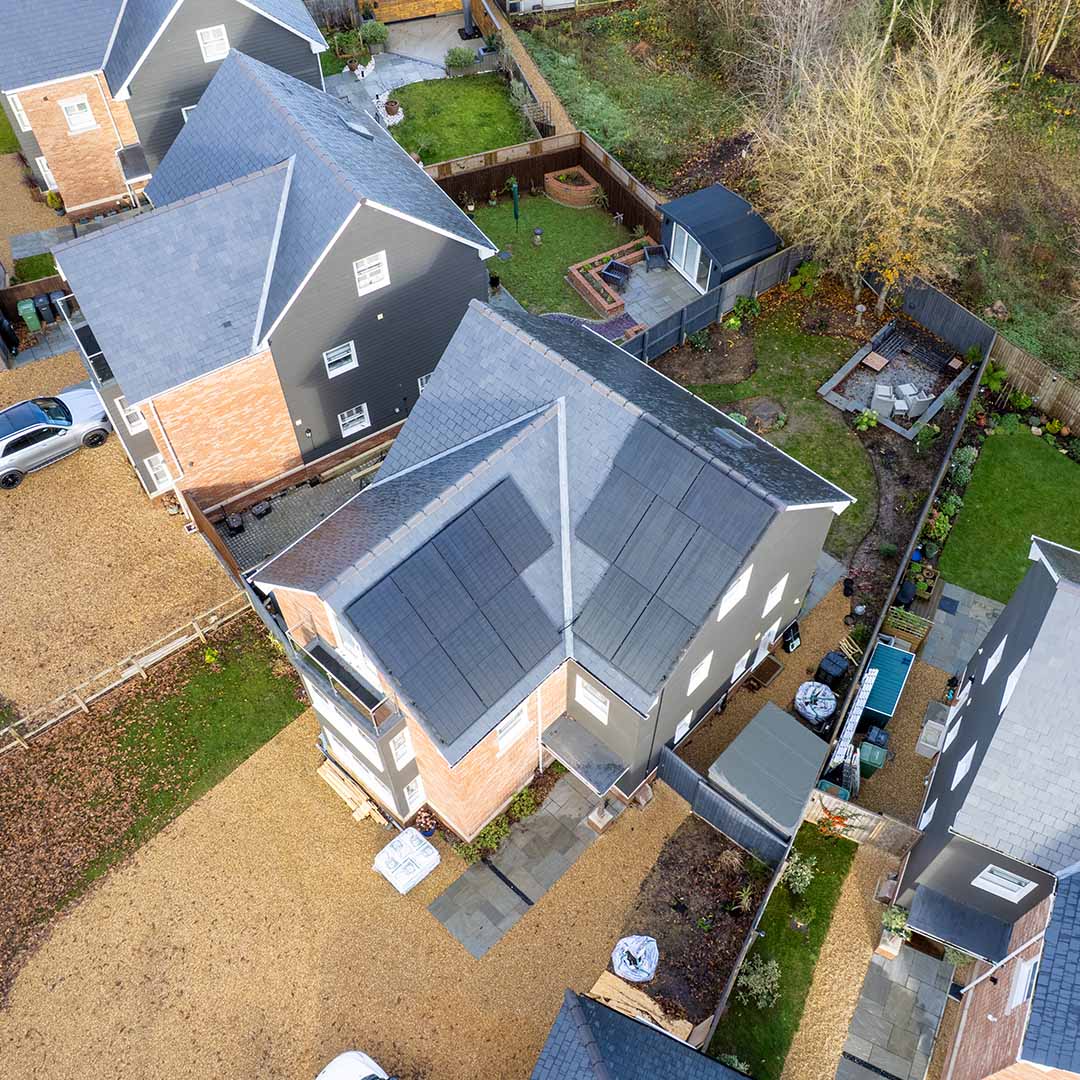
How charging an electric car from rooftop solar actually works in the real world, what it saves on the sunny South Coast, and the kit you need to make free solar miles a reality.
It is one of the most appealing ideas in home energy: park your electric car on the drive, let the sun top it up for free, and drive on sunshine. The good news is that charging your EV from solar panels genuinely works. The honest caveat is that how much free charging you get depends on timing, your kit and your daily routine. Here is a realistic look at what to expect, with South Coast conditions in mind.
The core idea is simple. When your solar panels generate more electricity than your house is using, that surplus normally flows out to the grid, earning you a few pence per unit under the Smart Export Guarantee. A solar-aware EV charger intercepts that surplus and sends it to your car instead. Because using your own solar is worth far more than exporting it, every unit you redirect into the car is money saved. On the sunny South Coast, with Solent-area irradiance around 1,050-1,150 kWh per kWp a year, there is more surplus to work with than in much of the UK.
In practice, a typical 4kW array on a bright Hampshire or Sussex day can produce a healthy surplus through the middle of the day once household demand is met. Feed that into the car and you can add a meaningful chunk of free range, perhaps 10-20 miles on a good day from surplus alone, sometimes much more in high summer. It will not fully charge a depleted car from solar on most days, but it can cover the everyday commuting and errands many households actually do.
The big variable is timing, and this is where honesty matters. Solar generation peaks around midday, so solar charging works best if your car is home during daylight: people who work from home, retirees, second cars, or anyone whose vehicle sits on the drive during the day. If your car is at work from nine to five, the sun is shining on an empty driveway. That does not make solar pointless, it just changes the strategy, which is where a home battery comes in.
Adding a home battery transforms solar EV charging. The battery stores your daytime surplus and releases it in the evening, so the car can charge from stored sunshine after you get home, or overnight. Combined with a smart tariff, you can also top the battery up at cheap off-peak rates and use it across the day. We cover this full ecosystem in our guide to solar, battery and EV charger setups, and for many customers it is the combination, not solar alone, that delivers the dream of consistently low-cost or free motoring.
The kit you need is straightforward: solar panels, a compatible solar-diverting charger such as a myenergi Zappi, and ideally a battery if your car is away during the day. The Zappi's eco modes are designed exactly for this, charging the car only from surplus, or topping up from the grid to a minimum if you need the car ready by a deadline. A good installer sizes and configures the whole system so it behaves the way your household actually lives, rather than leaving you to fiddle with apps.
Is it worth it? For South Coast homeowners with the right routine, the numbers are compelling. You are turning daytime generation that would otherwise export for pennies into miles that would otherwise cost you at the pump or a public rapid charger, where running costs can be four to five times your home rate. Over the life of the panels, solar-charged miles are one of the quickest ways to make a solar investment pay back faster.
If you already have solar and want to add a charger, or you are planning both together, the best first step is a free quote tailored to your roof, your car and your daily pattern. You can also run the numbers yourself with our solar and EV calculator to get a feel for the savings before you commit. We will give you the honest version of what solar charging will and will not do for your specific home, no hard sell attached.
Thinking about solar for your home?
We design every system around your roof and your real usage, across Hampshire, the Isle of Wight, Surrey, Sussex and Dorset. Get a free, no-obligation quote →
Cornerstone guide
Home EV Charger Installation: The Complete Guide →Read next
How Much Does It Cost to Install a Home EV Charger?
A clear, honest breakdown of what a home EV charger really costs to fit in Hampshire and along the South Coast, including the factors that move the price up or down.
EV Charger Installation: What to Expect (Survey to Switch-On)
A step-by-step walkthrough of a home EV charger installation on the South Coast, from the first survey through to the moment you plug in your car.
Do You Need an Electrician for an EV Charger?
Why a home EV charger is not a DIY job, what the regulations actually require, and how to make sure your installation is safe, legal and properly certified.