
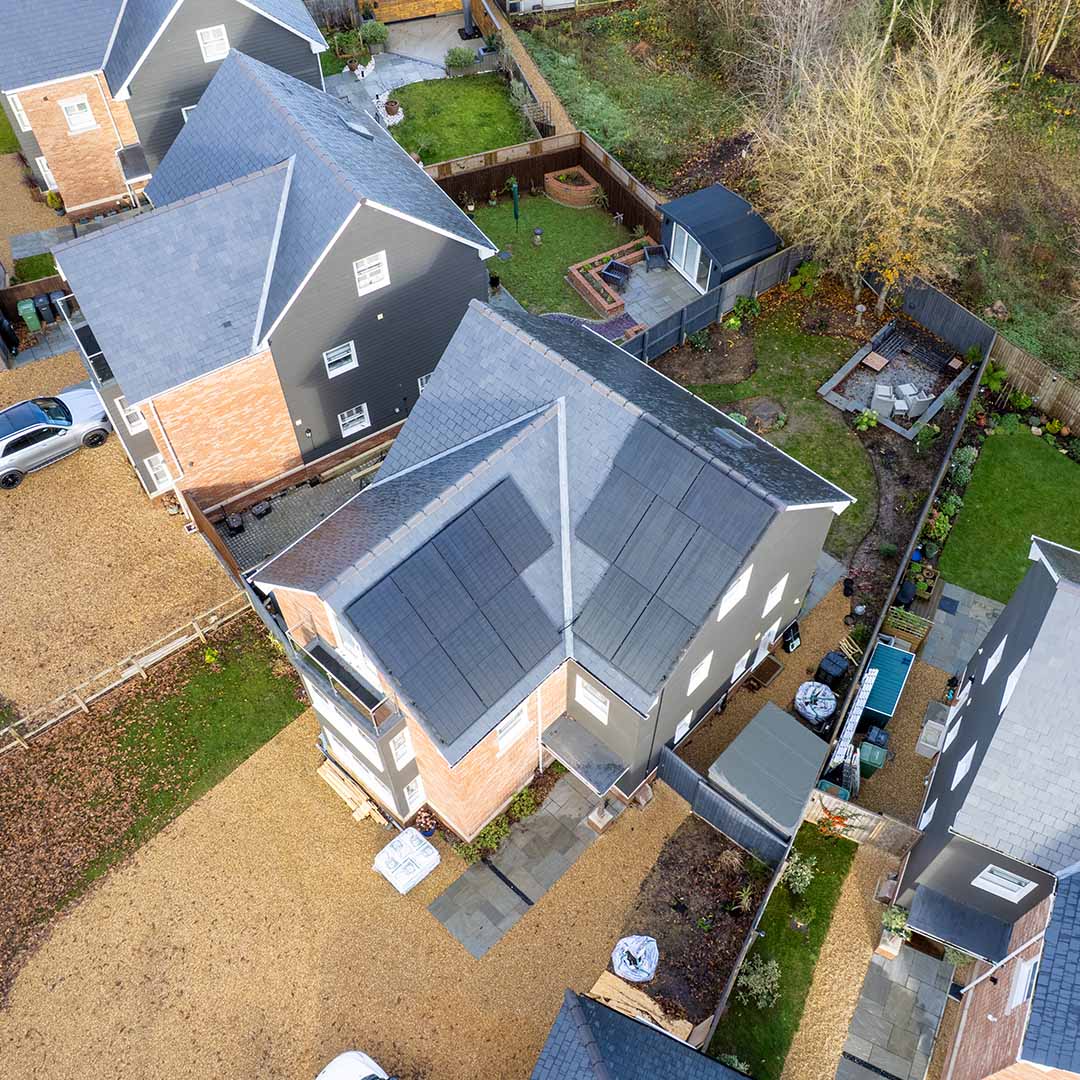
South-facing is ideal, but east, west and even north roofs can all make solar work. Here is what each orientation really delivers on a sunny South-Coast home.
One of the most common questions we hear from homeowners across Hampshire, Sussex, Surrey, Dorset and the Isle of Wight is whether solar is worth it if their roof does not face south. The short answer is yes, far more often than people assume. South-facing remains the textbook ideal, but east, west and even north-facing roofs can all generate worthwhile electricity — and thanks to the strong irradiance along the Solent coast, the numbers on a non-south roof here are better than they would be in many other parts of the UK. Let us go orientation by orientation.
A true south-facing roof at a pitch of roughly 30 to 40 degrees is the benchmark, capturing the most sunlight over the day and peaking at midday. We treat south as the 100% reference point. Everything else is measured against it — but the important thing to grasp is that the drop-off for other orientations is gentler than most people fear, especially in a sunny coastal region, and the shape of the generation curve can actually suit some households better than a midday peak does.
East and west roofs are the unsung heroes of UK solar. A panel facing east or west typically produces somewhere in the region of 80% to 85% of what the same panel would make facing south — a far smaller penalty than the word 'compromise' suggests. Better still, an east-facing array delivers in the morning while a west-facing array delivers in the afternoon and evening. If your home has an east-west roof (common on terraces and many modern estates around Portsmouth and Fareham), you can split panels across both slopes and enjoy a long, flat generation curve from breakfast through to supper. For a household that uses electricity at the start and end of the day rather than at noon, that spread often means you actually use more of your own solar power, which is where the real savings live.
North-facing roofs are where caution is warranted, but they are not automatically a write-off. A north-facing slope in the UK generally produces in the order of 60% to 70% of a south-facing equivalent — meaningfully less, but not nothing, particularly given the high light levels we enjoy on the South Coast. Where a north slope can make sense is on an east-west or hipped roof where it complements better-facing slopes, or on a generous roof where you simply want more total capacity and have the space for it. We would rarely recommend a north-only array as the core of a system, and we will always say so honestly, but as part of a larger, well-designed layout a north face can still add useful kilowatt-hours.
This is exactly where self-consumption and batteries change the maths. The financial value of solar comes largely from using your own electricity instead of buying it from the grid. A south array dumps a lot of its output in the middle of the day, when many households are out; an east-west array spreads generation across the hours people are actually home. Add a battery and the orientation question softens further, because you can store whatever you generate — morning sun from the east, evening sun from the west — and draw on it whenever you need it. Pair that with a time-of-use tariff such as one of Octopus's and the system works hard regardless of which way your roof points.
The Smart Export Guarantee also takes some of the pressure off orientation. Any electricity you do not use is exported to the grid and paid for under the SEG, so even the generation from a less-than-ideal slope earns you something rather than going to waste. Combined with the fact that residential solar currently carries 0% VAT, the case for putting panels on an east, west or supplementary north roof is stronger than many homeowners realise once you look past the simple 'must face south' rule of thumb.
Pitch and shading interact with orientation too, and we model all of them together. A shallower or steeper pitch shifts the numbers slightly, and the low winter sun behaves differently from the high summer sun on every aspect. Shading from chimneys, dormers, neighbouring buildings or the trees common in leafy parts of Surrey and West Sussex can matter more than orientation in practice — which is why, on multi-aspect and partially shaded roofs, we often pair non-south arrays with optimisers or microinverters so each panel produces independently and a weaker slope cannot drag down a stronger one.
The South-Coast climate quietly improves every one of these figures. With local irradiance commonly around 1,050 to 1,150 kWh per kWp each year, even an east, west or part-north array here can out-generate a south-facing system in a duller part of the country. The percentages above are relative to a south roof in the same location, so a strong baseline lifts all of them. In real terms, that means we are comfortable recommending solar on a far wider range of roofs along the Solent than the old 'south-only' wisdom would allow.
So if your roof faces east, west, or even north, do not rule out solar before you have had it properly assessed. The honest position is this: south is best, east and west are excellent and often better suited to how you actually use power, and north can play a supporting role on the right roof. The only way to know what your specific roof will deliver is a proper survey that models your aspects, pitch, shading and energy use. Book a free, no-obligation survey and we will tell you honestly what your roof can achieve — or try our online calculator for a quick first estimate.
Thinking about solar for your home?
We design every system around your roof and your real usage, across Hampshire, the Isle of Wight, Surrey, Sussex and Dorset. Get a free, no-obligation quote →
Cornerstone guide
Best Solar Panels UK 2026: Aiko, DMEGC & More Compared →Read next
Solar Panels for Complex, Hipped & Listed Roofs
Hipped roofs, dormers, listed buildings and conservation areas all add complexity to a solar install. Here is how a careful South-Coast survey turns awkward roofs into productive ones.
Microinverters vs String Inverters vs Optimisers
String inverter, optimisers or microinverters? The right choice depends mostly on your roof's shading and shape. Here is a plain-English guide for South-Coast homeowners.
Solar Panel Efficiency in 2026: What the Numbers Mean
Panel efficiency figures get a lot of marketing attention, but they matter less than most people think. Here is what the 2026 numbers actually mean for a South-Coast home.