
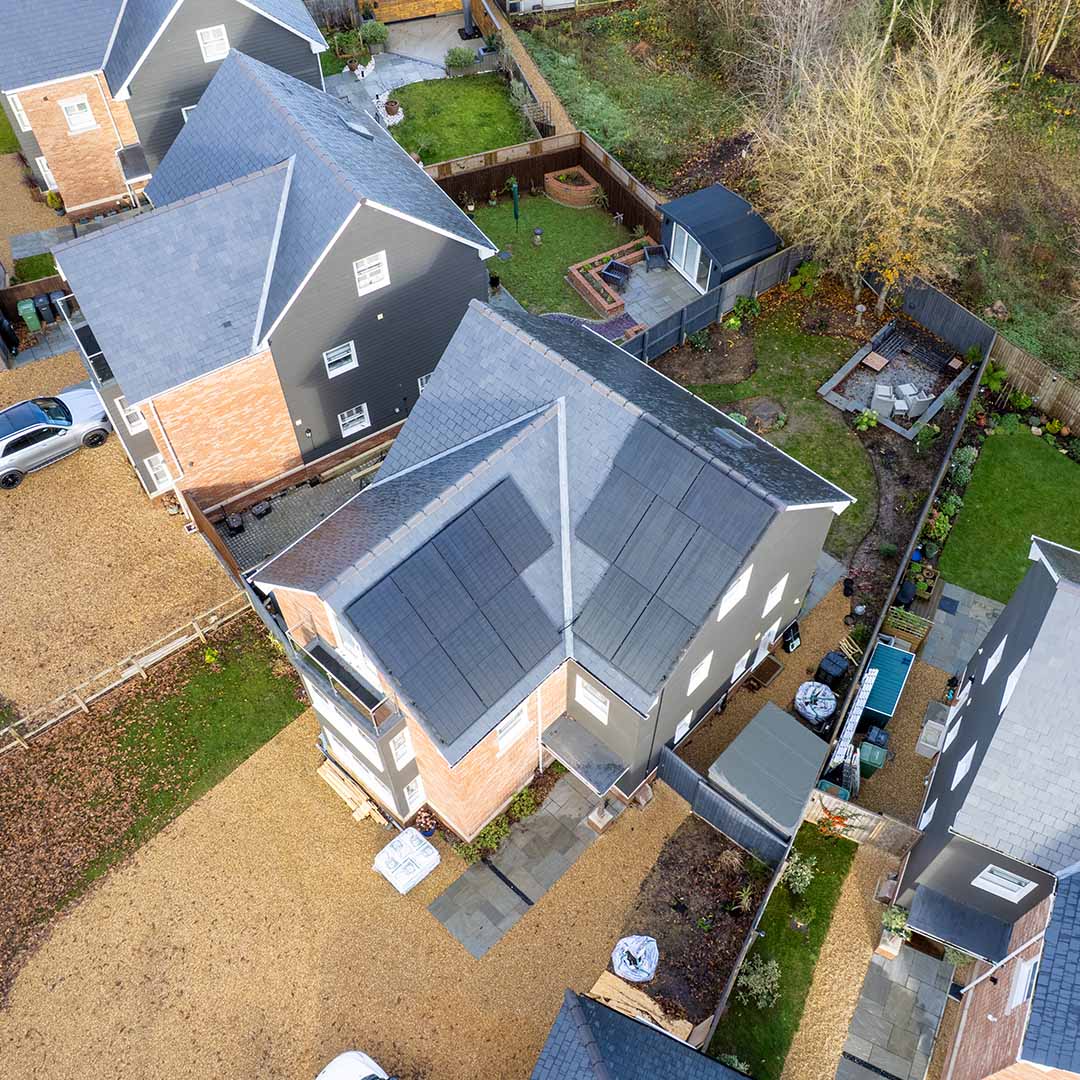
Hipped roofs, dormers, listed buildings and conservation areas all add complexity to a solar install. Here is how a careful South-Coast survey turns awkward roofs into productive ones.
Not every roof is a clean, south-facing rectangle. Across Hampshire, the Isle of Wight, Surrey, Sussex and Dorset we survey a huge variety of homes — Victorian terraces in Southsea with multiple chimneys, 1930s semis with hipped roofs in Fareham, thatched and tiled period properties near Winchester, and barn conversions out towards the Meon Valley. A complex roof does not rule out solar. It simply means the design work matters far more than the brochure power rating of the panels, and it is where an honest survey earns its keep.
Start with the most common awkward shape: the hipped roof. Instead of one large gable end, a hipped roof slopes inwards on all four sides, which breaks the available area into several triangular faces. The usable space on each face is smaller, and panels (which are rectangular) cannot follow the diagonal hip lines, so you lose a row of triangles at the edges. The practical consequence is that a hipped roof often holds fewer panels than a homeowner expects from the overall roof size. The good news is that a hip frequently gives you two or three usable aspects — often a south-east and a south-west face — which spreads generation across the day rather than concentrating it at midday. We measure each face individually and model them as separate strings or zones rather than assuming one big array.
Then there is shading and clutter. Period and complex roofs tend to carry chimneys, dormers, roof windows, valleys, soil vent pipes and the occasional satellite dish. Each of these can shade panels at certain times of day, and on a string inverter a single shaded panel can drag down a whole string. This is precisely the situation where panel-level electronics — microinverters or DC optimisers — prove their worth, because they let each panel produce independently. We map shadows across the day and across the seasons during the survey (the low winter sun behind a chimney behaves very differently from the high June sun) so the design reflects how your roof actually performs, not how it looks on a sunny afternoon.
Listed buildings and conservation areas are the other big consideration on the South Coast, where Chichester, Winchester and parts of Brighton & Hove all have significant protected stock. For most ordinary homes, solar panels are permitted development and need no planning application. That changes if your property is listed, in which case you will almost always need listed building consent, or if you are in a conservation area, an Area of Outstanding Natural Beauty or the South Downs National Park, where permitted development rights are more restricted — particularly for panels visible from a road or on a principal elevation. We never assume; we check the property's status with the local planning authority before quoting, because getting this wrong is not worth the risk to you or to us.
Where consent or sensitivity is an issue, the design can often still work — it just becomes more thoughtful. Options include placing panels on a rear or side roof slope that is not visible from the highway, using all-black panels with black frames and a black mounting system to minimise visual impact, or specifying integrated 'in-roof' systems that sit flush within the tiles rather than proud on rails. Conservation officers in the area are increasingly used to seeing tasteful solar on period homes, and a sympathetic, low-profile design genuinely improves the chances of approval. We are happy to provide drawings and panel specifications to support an application.
Roof structure and covering matter too. Older Hampshire and Sussex homes may have handmade clay tiles, slate, or even non-standard coverings that need careful handling and the correct flashing kit so the roof stays watertight for decades. Some period roofs have undersized or aged timbers, so we assess whether the structure can carry the additional load — a typical array adds only a modest weight, but it is always checked rather than assumed. If we find a roof that genuinely is not suitable, we will tell you plainly rather than installing something we are not confident in. That is part of what a no-pushy-sales survey means.
Output expectations should be realistic on a complex roof, and this is where the South Coast advantage helps. Our region enjoys some of the highest irradiance in the UK, typically around 1,050 to 1,150 kWh per kWp installed each year thanks to the Solent's relatively sunny, clear conditions. Even when a hipped or split roof spreads your panels across several aspects, the strong local sunlight means each well-placed panel still earns its keep. A multi-aspect system also tends to produce a flatter, more usable daily curve — useful if you are home in the mornings and evenings or charging a battery.
Speaking of batteries, complex roofs and battery storage go together well. If your roof can only host a modest array, a battery lets you make the very most of what it produces by storing daytime surplus for the evening, and it pairs neatly with a time-of-use tariff such as Octopus's. Any export you do send to the grid is rewarded through the Smart Export Guarantee, and as residential solar and battery installations currently attract 0% VAT, the economics are kinder than many homeowners expect. We will model a few sensible array-and-battery combinations for your specific roof rather than pushing the biggest system.
The bottom line is that hipped, dormered, multi-faceted, listed and conservation-area roofs are our daily work, not an exception. The difference between a disappointing install and a great one on these properties comes down to a meticulous survey, panel-level electronics where shading demands it, sympathetic product choices, and an honest conversation about what your particular roof can and cannot do. If you have a roof you think is 'too complicated' for solar, that is exactly the kind we like to look at. Book a free, no-obligation survey and we will tell you honestly what is possible — or try our online calculator for a first estimate.
Thinking about solar for your home?
We design every system around your roof and your real usage, across Hampshire, the Isle of Wight, Surrey, Sussex and Dorset. Get a free, no-obligation quote →
Cornerstone guide
Best Solar Panels UK 2026: Aiko, DMEGC & More Compared →Read next
Microinverters vs String Inverters vs Optimisers
String inverter, optimisers or microinverters? The right choice depends mostly on your roof's shading and shape. Here is a plain-English guide for South-Coast homeowners.
Solar Panel Efficiency in 2026: What the Numbers Mean
Panel efficiency figures get a lot of marketing attention, but they matter less than most people think. Here is what the 2026 numbers actually mean for a South-Coast home.
Do Solar Panels Work on North & East-West Roofs?
South-facing is ideal, but east, west and even north roofs can all make solar work. Here is what each orientation really delivers on a sunny South-Coast home.