
Panel efficiency figures get a lot of marketing attention, but they matter less than most people think. Here is what the 2026 numbers actually mean for a South-Coast home.
Walk into any solar conversation in 2026 and you will hear about efficiency — panels advertised at 21%, 22%, even 23% and beyond. It sounds like a headline spec that should dominate your decision, in the way that miles-per-gallon used to dominate car buying. In reality, panel efficiency is one of the more misunderstood numbers in the industry, and for most South-Coast homeowners it is far from the most important thing. Let us unpack what the figure actually means and where it genuinely matters.
Efficiency is simply the percentage of the sunlight landing on a panel that the panel converts into electricity. A 22% efficient panel turns 22% of the solar energy hitting its surface into usable power; the rest is reflected or lost as heat. Crucially, efficiency is about how much power you get per square metre of roof, not about some magic quality that makes the electricity 'better'. A higher-efficiency panel produces more watts from the same physical area. That is the whole story — and it explains exactly when the number matters and when it does not.
In 2026, mainstream residential panels from quality manufacturers typically sit somewhere around 21% to 23% efficiency, using technologies such as TOPCon and increasingly heterojunction (HJT) and back-contact cells. A decade ago, 17% to 18% was considered good, so the whole market has moved up. The practical effect is that the gap between a 'standard' good panel and a 'premium' high-efficiency panel is now fairly narrow — often just one or two percentage points. That difference is real, but it is not the chasm the marketing sometimes implies, and it should be weighed against price, warranty and brand reliability rather than chased for its own sake.
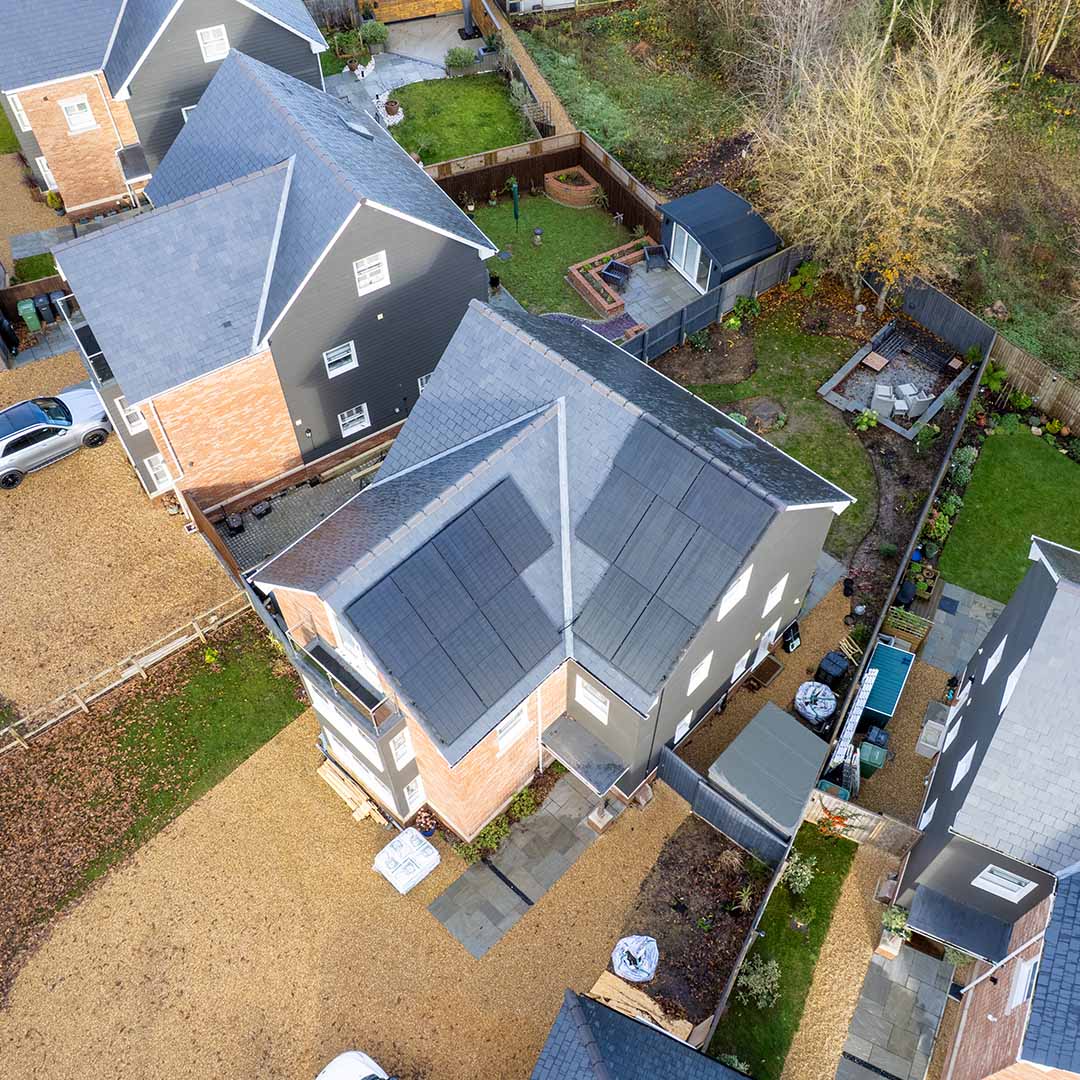
Here is the key insight: efficiency matters most when roof space is tight. If you have a small or awkward roof — a compact terrace in Southsea, a hipped roof that only offers a couple of usable triangles, or a property where you want maximum generation from a limited area — then squeezing more watts out of every square metre is genuinely valuable, and paying for higher-efficiency panels can be the right call. If you have plenty of unshaded roof, you can often reach your target output with standard-efficiency panels and simply fit one or two more of them, usually at lower overall cost. We size to your roof and your energy needs, not to a spec-sheet bragging right.
It also helps to understand the difference between the lab number and real-world performance. The headline efficiency is measured under Standard Test Conditions — a fixed temperature, a defined light intensity and a set spectrum. Your roof in Portsmouth in July is hotter than the lab, and panels lose a little output as they heat up; this is captured by the 'temperature coefficient', and a better coefficient means a panel holds its performance on hot days. Conversely, on bright but cool South-Coast mornings panels can briefly outperform their rating. When comparing panels, the temperature coefficient and low-light behaviour can matter as much as the headline efficiency, especially given how often our weather is bright but not blazing.
Two related figures deserve attention. The first is the power rating in watts (for example, a 440 W or 450 W panel), which tells you the output of that specific panel under test conditions — a more practical number than efficiency for working out how many panels fit your roof and your demand. The second is the degradation warranty: panels slowly lose output over their life, and good 2026 panels guarantee around 87% to 92% of their original output after 25 years, with the best back-contact and HJT panels at the higher end. A panel that degrades slowly will quietly out-earn a slightly higher-efficiency panel that fades faster, so we look at the whole 25-year picture.
For the South Coast specifically, the local climate flatters all of this. Our region receives some of the strongest irradiance in the UK, commonly around 1,050 to 1,150 kWh per kWp each year, because the Solent coast tends to be clearer and sunnier than much of the country. That means even sensible, mid-range, good-value panels generate strongly here — you do not need to buy the absolute top of the efficiency table to get an excellent result. High irradiance combined with a well-designed system is what drives real returns, not chasing the last fraction of a percent on a data sheet.
None of this means efficiency is meaningless — it simply needs to be kept in proportion. A reputable, reasonably efficient panel from a manufacturer with a strong track record, a sensible degradation warranty and a good temperature coefficient, installed correctly and sized properly for your roof, will serve you far better than a chart-topping efficiency figure attached to an unknown brand or a poorly designed layout. Installation quality, the inverter strategy and accurate sizing routinely make a bigger difference to your annual yield than a one-point efficiency gap.
So when you are comparing quotes in 2026, treat efficiency as one input among several rather than the deciding number. Ask about the panel's power rating, its 25-year degradation guarantee, its temperature coefficient and the manufacturer's reputation and warranty support in the UK — and make sure the system is sized to your actual roof and consumption. We are always happy to explain exactly why we have specified a particular panel for your home, in plain English and with no jargon or hard sell. Book a free survey and we will recommend the right panels for your roof and budget, or use our calculator to estimate the output you could expect.
Thinking about solar for your home?
We design every system around your roof and your real usage, across Hampshire, the Isle of Wight, Surrey, Sussex and Dorset. Get a free, no-obligation quote →
Cornerstone guide
Best Solar Panels UK 2026: Aiko, DMEGC & More Compared →Read next
Solar Panels for Complex, Hipped & Listed Roofs
Hipped roofs, dormers, listed buildings and conservation areas all add complexity to a solar install. Here is how a careful South-Coast survey turns awkward roofs into productive ones.
Microinverters vs String Inverters vs Optimisers
String inverter, optimisers or microinverters? The right choice depends mostly on your roof's shading and shape. Here is a plain-English guide for South-Coast homeowners.
Do Solar Panels Work on North & East-West Roofs?
South-facing is ideal, but east, west and even north roofs can all make solar work. Here is what each orientation really delivers on a sunny South-Coast home.