
String inverter, optimisers or microinverters? The right choice depends mostly on your roof's shading and shape. Here is a plain-English guide for South-Coast homeowners.
Your solar panels produce direct current (DC), but your home and the grid run on alternating current (AC), so every solar system needs an inverter to do the conversion. It is one of the hardest-working components on the system and, after the panels themselves, the choice that most affects how much energy you actually harvest. There are three main approaches — a single string inverter, a string inverter with panel-level optimisers, or microinverters — and the right one depends far more on your roof than on any single product being 'the best'. Here is how we think about it on South-Coast homes.
A string inverter is the traditional and most common setup. Your panels are wired in series into one or more 'strings', and the combined DC is fed to a single inverter, usually mounted in the loft, garage or on an outside wall. It is the simplest and generally the cheapest approach, with one box to install and maintain. The catch is the way a series string behaves: the whole string tends to perform at the level of its weakest panel. If one panel is shaded by a chimney, a dormer or a passing tree shadow, the output of every panel on that string can be pulled down with it. On a clean, unshaded, single-aspect roof — think a south-facing 1990s semi in Havant with nothing in the way — a string inverter is often the sensible, cost-effective choice.
Optimisers are a clever middle ground. You still have a single string inverter, but each panel gets a small electronic device fitted behind it. The optimiser conditions that panel's output so a shaded or underperforming panel no longer drags down its neighbours — each panel can effectively do its own thing while the central inverter still does the DC-to-AC conversion. The big practical bonus is panel-level monitoring: through an app you can see exactly how each panel is doing and spot a fault or a new shading problem quickly. The trade-offs are a higher cost than a plain string system and more individual components on the roof, each of which is a potential (if rare) point of failure. For partially shaded or multi-aspect roofs that still suit a central inverter, optimisers are frequently our recommendation.
Microinverters take the idea further by putting a tiny inverter under each individual panel, so the DC-to-AC conversion happens right there on the roof. There is no central inverter box at all. Because every panel operates completely independently, microinverters handle shading and complex, multi-aspect roofs extremely well — a shaded panel on the north-east face simply produces less while the south-west panels carry on at full tilt. You also get detailed per-panel monitoring, and because the system runs at safer low-voltage AC on the roof rather than high-voltage DC, some homeowners prefer them on safety grounds. They are typically the most expensive option per panel, and the electronics live up on the roof where they are exposed to the elements, though quality units are built for it and carry long warranties.
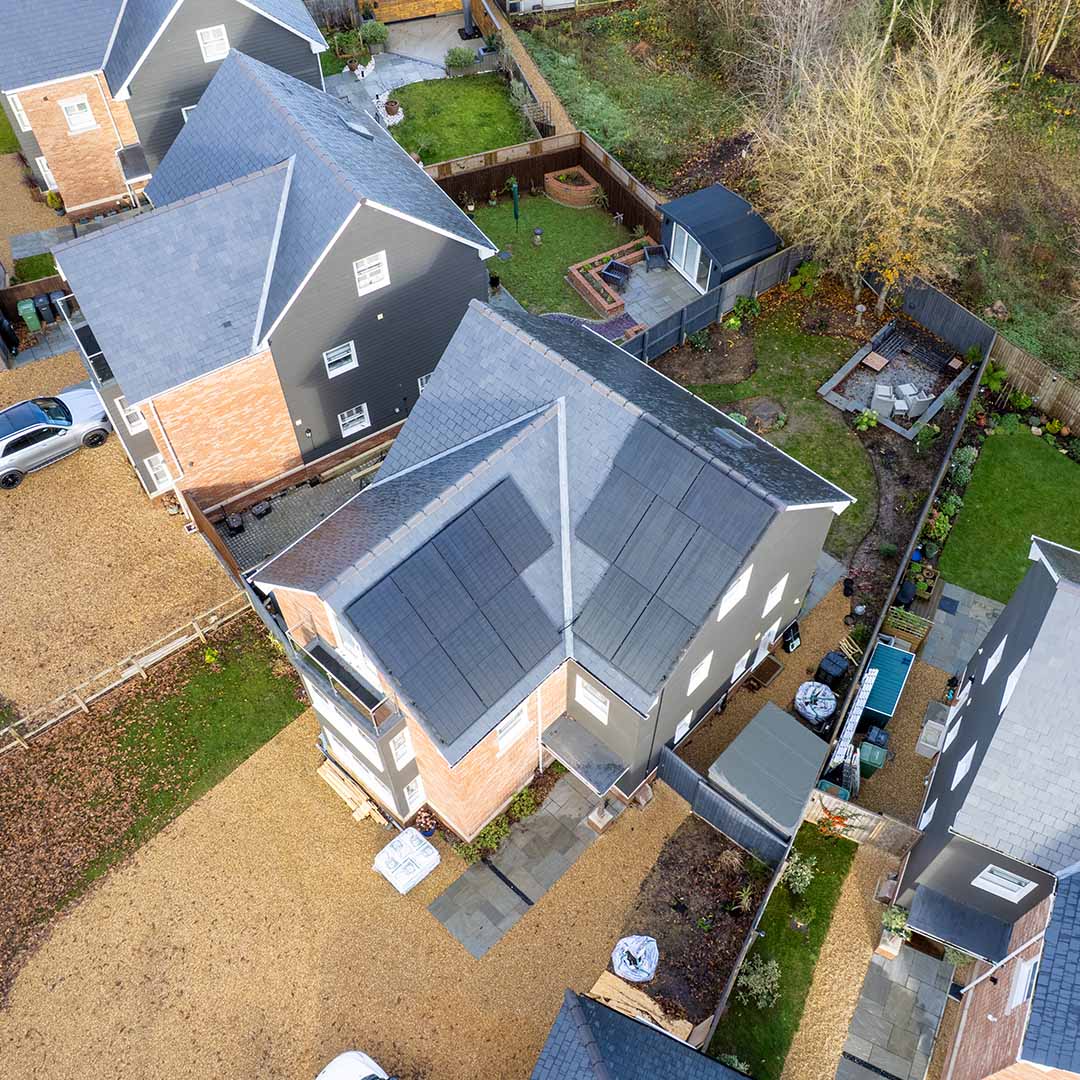
So how do we choose? The deciding factor is almost always shading and roof geometry. If your roof is a single clean aspect with no obstructions, a string inverter gives you the best value and there is little to gain from spending more. If you have some shading — a chimney, a neighbour's tree, a dormer — or a couple of roof aspects, optimisers usually offer the best balance of performance and cost. If your roof is genuinely complex, heavily shaded, or split across three or more faces (common on the hipped and period roofs we see around Portsmouth, Southsea and Winchester), microinverters often recover enough extra energy over the system's life to justify the premium.
Monitoring deserves a mention in its own right, because it changes the ownership experience. With a plain string inverter you typically see whole-system output; if one panel quietly fails, you might not notice for months. Both optimisers and microinverters give you panel-by-panel visibility, so a problem shows up immediately and we can pinpoint it without guesswork. Over a 25-year system life, that early warning can mean the difference between a quick fix and a long stretch of lost generation you never knew about.
Warranties and longevity are worth weighing too. A good string inverter often carries a 10-to-12-year warranty and may need replacing once during the panels' 25-plus-year life, which is a known and budgetable cost. Quality microinverters and optimisers tend to come with 20-to-25-year warranties that better match the panels, so in principle there is less to replace mid-life — though there are more individual units in play. We will always quote the actual warranty terms for the specific products we recommend so you can compare like for like rather than relying on marketing headlines.
It is also worth saying that the inverter choice interacts with batteries and tariffs. Some inverters are 'hybrid' units designed to manage a battery directly, which can simplify a future battery addition; others need a separate battery inverter. If you are on, or planning to move to, a time-of-use tariff such as one of Octopus's, a hybrid setup makes it easier to charge from cheap overnight electricity and store your own daytime surplus. We factor your plans — battery now, battery later, or never — into the inverter recommendation so you are not boxed in.
In short, there is no single winner. A string inverter wins on value for simple roofs; optimisers win on flexibility for moderately shaded or split roofs; microinverters win on performance for the most complex and shaded roofs. The honest answer for your home only comes from looking at your actual roof, its aspects and its shadows across the day. We will explain which option we would fit and why, in plain terms, with no pressure to over-specify. Book a free survey and we will recommend the right inverter strategy for your roof — or use our calculator to get a first idea of system size and output.
Thinking about solar for your home?
We design every system around your roof and your real usage, across Hampshire, the Isle of Wight, Surrey, Sussex and Dorset. Get a free, no-obligation quote →
Cornerstone guide
Best Solar Panels UK 2026: Aiko, DMEGC & More Compared →Read next
Solar Panels for Complex, Hipped & Listed Roofs
Hipped roofs, dormers, listed buildings and conservation areas all add complexity to a solar install. Here is how a careful South-Coast survey turns awkward roofs into productive ones.
Solar Panel Efficiency in 2026: What the Numbers Mean
Panel efficiency figures get a lot of marketing attention, but they matter less than most people think. Here is what the 2026 numbers actually mean for a South-Coast home.
Do Solar Panels Work on North & East-West Roofs?
South-facing is ideal, but east, west and even north roofs can all make solar work. Here is what each orientation really delivers on a sunny South-Coast home.