
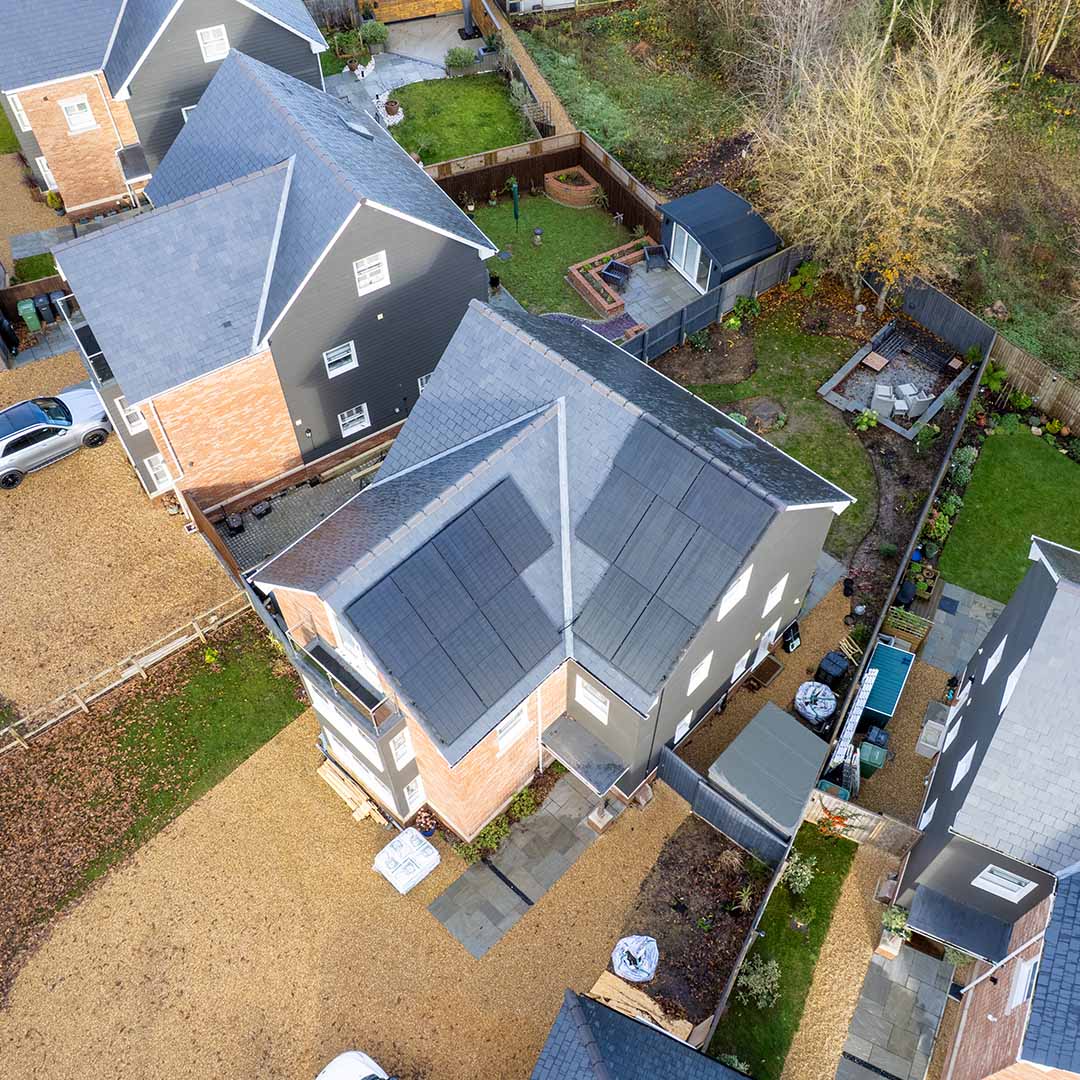
South-facing roofs win on total yield, but east-west arrays often deliver better real-world savings. Here is how to decide for your South Coast home.
One of the most common questions we hear from homeowners across Hampshire, Surrey, Sussex and Dorset is whether their roof faces the right way for solar. There is a persistent myth that you need a south-facing roof or solar is not worth it. That simply is not true — and in many households an east-west split roof actually delivers better value than a south-facing one. Here is the honest breakdown.
On pure annual generation, a south-facing roof wins. Panels facing due south at a pitch of around 35-40 degrees capture the most sunlight over a full year and produce the highest total kilowatt-hours. If your roof faces south and is unshaded, you are starting from the strongest position, and on the South Coast — where irradiance runs at roughly 1,050-1,150 kWh per kWp — that adds up to a lot of generation.
But total generation is not the same as total savings, and this is where east-west arrays come into their own. A south-facing array produces a tall spike of power around midday. The problem is that most households are out at work or school at midday, so much of that peak generation gets exported to the grid rather than used in the home. Under the Smart Export Guarantee you are paid for exports, but the rate you receive is usually lower than the rate you pay to buy electricity. Every unit you use yourself is worth more than every unit you export.
An east-west split array changes the shape of your generation. Instead of one midday peak, you get a broad curve: the east-facing panels generate strongly in the morning as people are getting ready and using appliances, and the west-facing panels carry generation through the afternoon and into the early evening when families return home, cook and switch things on. The total annual output is typically only around 10-15% lower than an equivalent south-facing array, but because so much more of it is consumed directly in the home, the financial return can actually be better.
Self-consumption is the metric that really matters. A south-facing home without a battery might self-consume only 35-40% of what it generates, exporting the rest. An east-west home naturally lifts that figure because generation lines up better with daily usage. Add a battery to either configuration and self-consumption can climb to 70-80%, which is where the strongest bill savings appear. If you are out during the day and don't yet have a battery, an east-west roof is often the more sensible starting point.
Pitch and shading still matter on either orientation. A very shallow or very steep roof shifts the numbers, and a chimney or tree shadow can drag down output regardless of which way the roof faces. On east-west roofs we pay particular attention to morning and afternoon shading, since that is when each side does its work. Where shading is genuine, panel-level optimisers or shade-tolerant panels like Aiko can recover output that a basic string setup would lose.
Local grid arrangements are the same whichever way your roof faces. Homes in Hampshire, the Isle of Wight and Dorset connect via SSEN, while most of Sussex and Surrey fall under UKPN, and we handle the relevant notification as part of the install. None of this changes based on orientation — it is simply part of getting your system connected and earning export payments correctly.
The bottom line: don't write off solar because your roof doesn't face south. A south-facing roof gives the highest raw generation, but an east-west array often gives better real-world savings for households that use most of their power at the start and end of the day. The right answer depends on your roof, your routine and whether you add storage. The quickest way to see the difference for your home is to run the numbers with our free solar panel calculator, then book a free, no-obligation quote and we will model both options honestly so you can choose with confidence.
Thinking about solar for your home?
We design every system around your roof and your real usage, across Hampshire, the Isle of Wight, Surrey, Sussex and Dorset. Get a free, no-obligation quote →
Cornerstone guide
Best Solar Panels UK 2026: Aiko, DMEGC & More Compared →Read next
Solar Panels for Complex, Hipped & Listed Roofs
Hipped roofs, dormers, listed buildings and conservation areas all add complexity to a solar install. Here is how a careful South-Coast survey turns awkward roofs into productive ones.
Microinverters vs String Inverters vs Optimisers
String inverter, optimisers or microinverters? The right choice depends mostly on your roof's shading and shape. Here is a plain-English guide for South-Coast homeowners.
Solar Panel Efficiency in 2026: What the Numbers Mean
Panel efficiency figures get a lot of marketing attention, but they matter less than most people think. Here is what the 2026 numbers actually mean for a South-Coast home.