
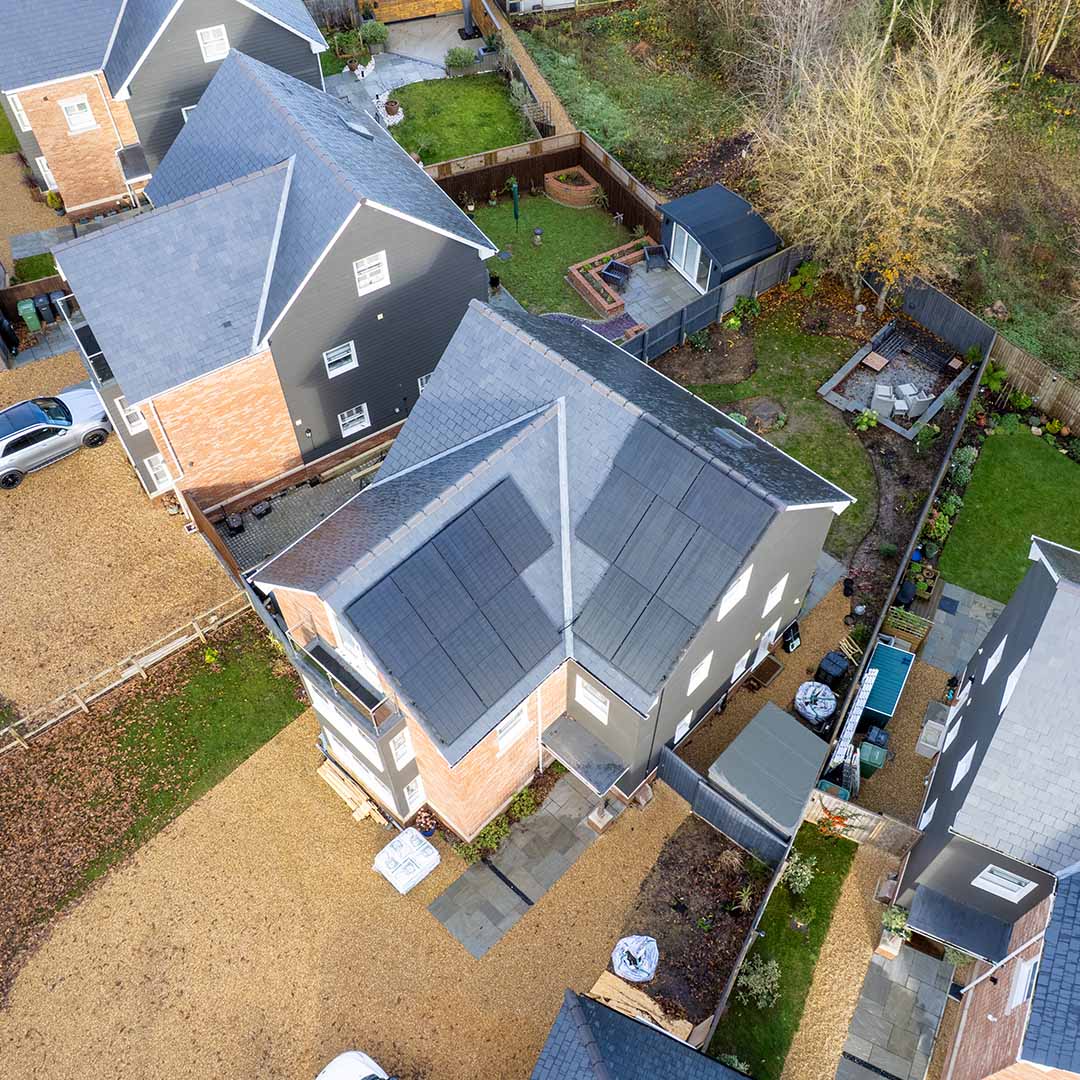
Solar panels can lift your home's EPC rating, which matters for landlords under MEES rules and for any homeowner thinking about future resale. Here's how it works on the South Coast.
An Energy Performance Certificate, or EPC, rates a property's energy efficiency from A (most efficient) down to G (least efficient), and it has quietly become one of the more important numbers attached to your home. It is required whenever a property is sold or let, it lasts for ten years, and it increasingly influences mortgage products, rental compliance and buyer expectations. If you are weighing up solar panels, it is worth understanding how they affect your EPC — and, if you are a landlord, why the rules known as MEES make that connection more than academic.
First, the honest picture on how much solar lifts your rating. An EPC is calculated using a standardised model called RdSAP, which estimates running costs and carbon emissions based on the building's fabric, heating system, and any low-carbon technology installed. Solar photovoltaic panels are recognised by that model and do improve the score, because they reduce the assessed cost of the energy the home uses. A typical domestic solar array might lift a home by several points and, for properties sitting near a band boundary, can be enough to nudge a D up to a C, or a C up to a B. The exact gain depends on the system size, your roof orientation and the starting point of the property — solar generally moves the needle most on homes that are already reasonably insulated and electrically heated, and less on homes whose main weakness is poor insulation or an old gas boiler.
That last point is the key to using solar wisely for EPC purposes. The model rewards a balanced home. If your property loses heat through an uninsulated loft or single glazing, fixing the fabric first will usually give you more EPC points per pound than panels alone, and it makes any solar you add work harder because the home wastes less of what it generates. The sensible order is almost always: insulate, then consider heating, then add solar to cover the electricity you do use. Done in that sequence, solar becomes the part of the package that pushes a borderline home cleanly into a higher band.
This is where MEES — the Minimum Energy Efficiency Standards — comes in, and why landlords in particular need to pay attention. Since April 2020, it has been unlawful in England and Wales to let, or continue to let, most domestic private rented properties with an EPC rating below E, unless a valid exemption is registered. In practice that means a property rated F or G generally cannot be let, and breaches can attract financial penalties from the local authority. The minimum standard is the current legal line in the sand, and any landlord with a borderline property should already be acting on it.
The direction of travel is the part that should focus minds. The government has consulted on raising the minimum standard for private rented homes, with proposals discussed around a higher EPC band (commonly cited as C) and target dates later this decade. The precise threshold and timetable are not yet fixed in law, so we will not quote a specific year as certain — but the trajectory is clearly upward, and landlords who improve now are insulating themselves against a moving target rather than scrambling later. For a portfolio landlord on the South Coast, getting properties comfortably above the likely future line, rather than just over today's, is the prudent play.
For owner-occupiers, MEES does not apply directly — no one will stop you living in an F-rated home — but the EPC still matters at resale and increasingly at mortgage stage. A growing number of lenders offer 'green' mortgage products or preferential rates for higher-rated homes, and energy efficiency is becoming a routine question for buyers facing high energy bills. A solar installation that lifts your band, paired with the visible benefit of lower running costs, is a genuine selling point that a flat-roofed extension or a new kitchen simply does not replicate.
A few practical notes for the South Coast specifically. If you want solar reflected in your EPC, the panels need to be on the certificate, so you will want an updated assessment after installation — keep your MCS certificate and commissioning paperwork, as the assessor will use them. Bear in mind that homes in conservation areas in Chichester, Winchester or Brighton may face planning considerations on panel placement (covered in our planning guides), which can affect how large a system you can fit and therefore the EPC uplift available. And remember that the EPC model assumes typical usage; your real-world benefit, helped by the high Solent irradiance of roughly 1,050 to 1,150 kWh per kWp a year, is often better than the certificate's conservative figures suggest.
To sum up: solar panels reliably improve an EPC and can be the deciding factor in moving a borderline home up a band, but they work best as part of a sensible whole-home approach rather than a lone fix. For landlords, that EPC uplift is not just a nicety — it is about staying the right side of MEES today and getting ahead of tighter standards tomorrow. For owner-occupiers, it adds resale appeal and may open up better mortgage options. If you would like us to look at your roof and give an honest estimate of the system size, the likely EPC effect and the costs involved, we are glad to help with no pressure, or you can run the numbers yourself using our solar calculator.
Thinking about solar for your home?
We design every system around your roof and your real usage, across Hampshire, the Isle of Wight, Surrey, Sussex and Dorset. Get a free, no-obligation quote →
Cornerstone guide
Solar Panel Grants & Planning on the South Coast (2026) →Read next
Solar Together Hampshire: Is Collective Buying Worth It?
Solar Together is a council-backed group-buying scheme that promises discounted solar through bulk purchasing. We explain how it works on the South Coast and where it helps — and where it falls short.
Warm Homes Local Grant & ECO4: Do You Qualify?
Government-backed energy efficiency schemes can fund solar and other improvements for some households. We explain who qualifies for the Warm Homes Local Grant and ECO4 on the South Coast — honestly.
0% VAT on Solar Panels: What's Covered and Until When?
Residential solar and battery installations currently carry 0% VAT, a significant saving for homeowners. We explain exactly what's covered, what isn't, and how long the relief is expected to last.