
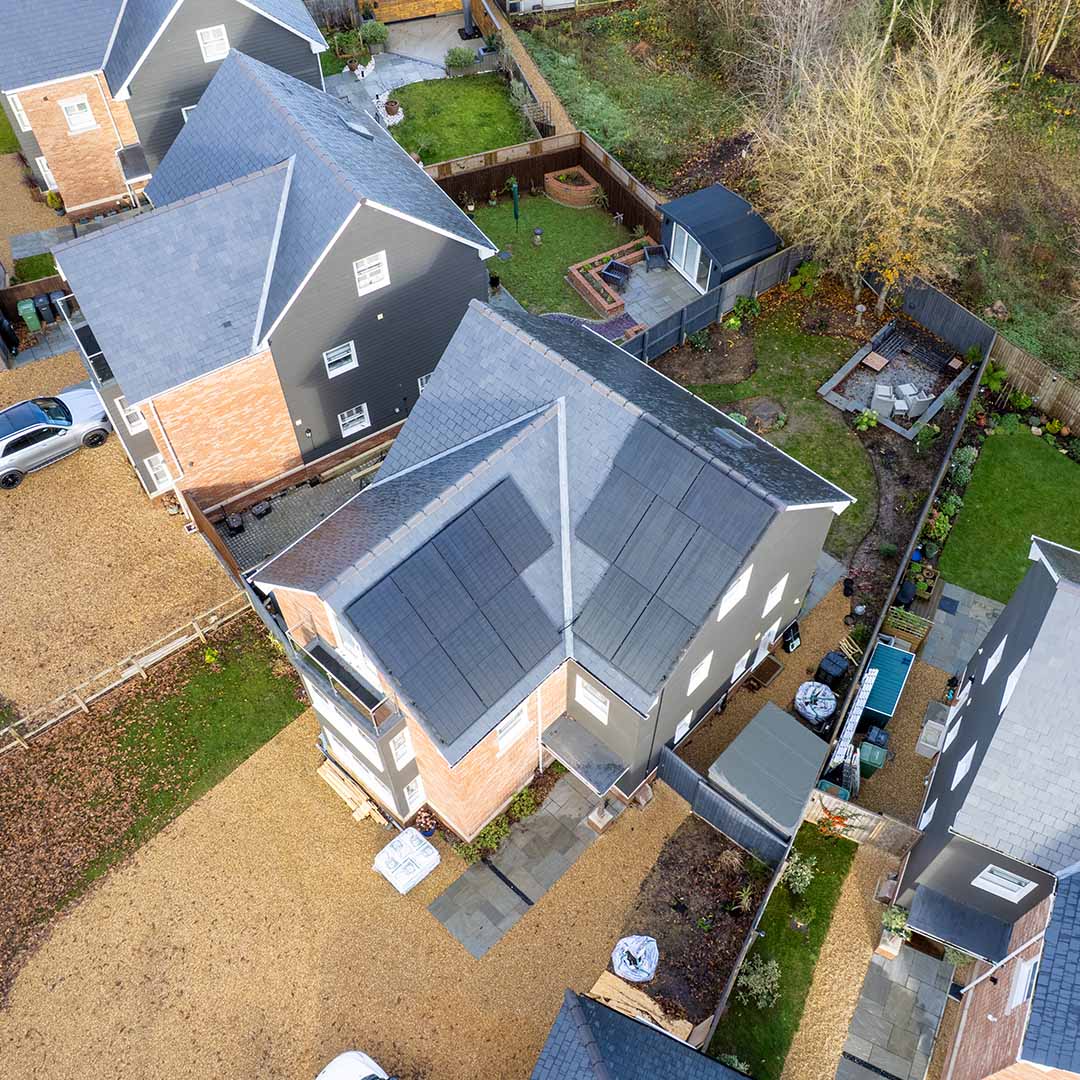
How solar panels, a home battery and a smart EV charger work together as one system, what it costs, and why the combination delivers the biggest savings for South Coast homes.
Solar panels are great. A home battery is great. A smart EV charger is great. Put all three together, though, and you get something more than the sum of the parts: a home energy system that generates its own power, stores it, and pours it into both your house and your car at the cheapest possible cost. For South Coast homeowners with an electric vehicle, this is the setup that delivers the lowest running costs and the most independence from rising energy prices. Here is how the pieces fit together.
Start with the panels. On the sunny South Coast, where irradiance runs around 1,050-1,150 kWh per kWp a year, a typical home array generates well during daylight, often more than the house needs at midday. Without a battery or EV charger, that surplus exports to the grid for a modest Smart Export Guarantee payment. The whole point of a complete setup is to capture that surplus and use it where it is worth far more, in your battery and your car, rather than selling it cheaply.
The battery is the linchpin. It stores daytime solar surplus and releases it when you need it, in the evening peak, overnight, or to charge the car after you get home from work. It also lets you play the tariff game: on an EV tariff such as Octopus Intelligent Go, you can charge the battery from the grid during the cheap overnight window and run your home from it during expensive daytime hours. The battery is what frees you from having to be home at midday to benefit from solar, which is the single biggest limitation of solar EV charging on its own.
The smart charger ties the car into the system. A solar-aware charger like a myenergi Zappi can pull surplus solar straight into the car when the sun is out and the battery is full, or draw from cheap off-peak grid power overnight, all automatically. You set the target charge and deadline, and the system works out the cheapest route to get there using sunshine, stored battery energy and off-peak rates in whatever combination is cheapest at the time. The result is a car that is, much of the time, charged on energy that cost you very little or nothing.
How the three interact through a typical South Coast day looks like this. In the morning, the house runs on solar as generation ramps up. By midday, surplus charges the battery and, if the car is home, diverts into it too. Through the afternoon the battery fills. In the evening, when generation drops and demand rises, the house and car draw from the stored battery rather than the expensive grid. Overnight, if needed, the system tops up the battery and car at the cheap off-peak rate, ready for the next day. It is a continuous, automated cycle that quietly minimises your bills.
What does it cost? A combined system is a bigger investment than any single component, but the components share installation, scaffolding and electrical work, so a bundle is usually better value than buying piecemeal over several years. Prices vary widely with system size, battery capacity and your home's electrics, so we always quote from a survey rather than a headline number. As a family-run, MCS-certified installer, we will give you honest ranges and a fixed price, never invented figures or pressure to oversize the system.
There is a technical point worth knowing. A combined solar, battery and higher-load EV setup can draw or push enough power that your DNO, SSEN across Hampshire, the Isle of Wight and Dorset, or UKPN in Sussex and most of Surrey, may require a prior application rather than a simple after-the-fact notification. This can take a few weeks for approval, so it pays to plan ahead. We manage the whole DNO process for you, so it is one less thing to worry about, but it is a reason to talk to an installer early rather than at the last minute.
If your home in a conservation area around Chichester, Winchester or Brighton raises questions about panel placement, that is something we factor into the design too. The aim of a complete setup is always to fit your home and your life, not a one-size-fits-all template.
The complete solar, battery and EV charger setup is the closest most homeowners get to energy independence, and on the sunny South Coast the economics stack up better than in most of the country. If you want to see what the combination could save you, run your numbers in our solar and EV calculator, then get a free, no-obligation quote. We will design the system around how you actually live, and tell you honestly which parts make sense to do now and which can wait.
Thinking about solar for your home?
We design every system around your roof and your real usage, across Hampshire, the Isle of Wight, Surrey, Sussex and Dorset. Get a free, no-obligation quote →
Cornerstone guide
Home EV Charger Installation: The Complete Guide →Read next
How Much Does It Cost to Install a Home EV Charger?
A clear, honest breakdown of what a home EV charger really costs to fit in Hampshire and along the South Coast, including the factors that move the price up or down.
EV Charger Installation: What to Expect (Survey to Switch-On)
A step-by-step walkthrough of a home EV charger installation on the South Coast, from the first survey through to the moment you plug in your car.
Do You Need an Electrician for an EV Charger?
Why a home EV charger is not a DIY job, what the regulations actually require, and how to make sure your installation is safe, legal and properly certified.